
In working with clients, the most time is spent not on creating content, but on organizing the process. It's unclear who should check what, which posts are already ready, and where the latest version has gone. Postmypost helps eliminate unnecessary steps.
In this article, we discuss how to set up convenient approvals and write reports faster.
First - Breakdown into Stages
Stages are the foundation of the working process in Postmypost. They show the team at what step each post is, who is responsible for the next step, and which tasks require attention. Thanks to flexible settings, stages can easily be adapted to your working style - for a single specialist, a small team, or a multi-tiered company.
Stages address several typical problems: disappearing files, confusion in chats, and endless clarifications of "what about this post?".
To customize the steps for your tasks, click on the "Workflow" section and the "Create Stage" button. Name the stage and choose the transition logic.
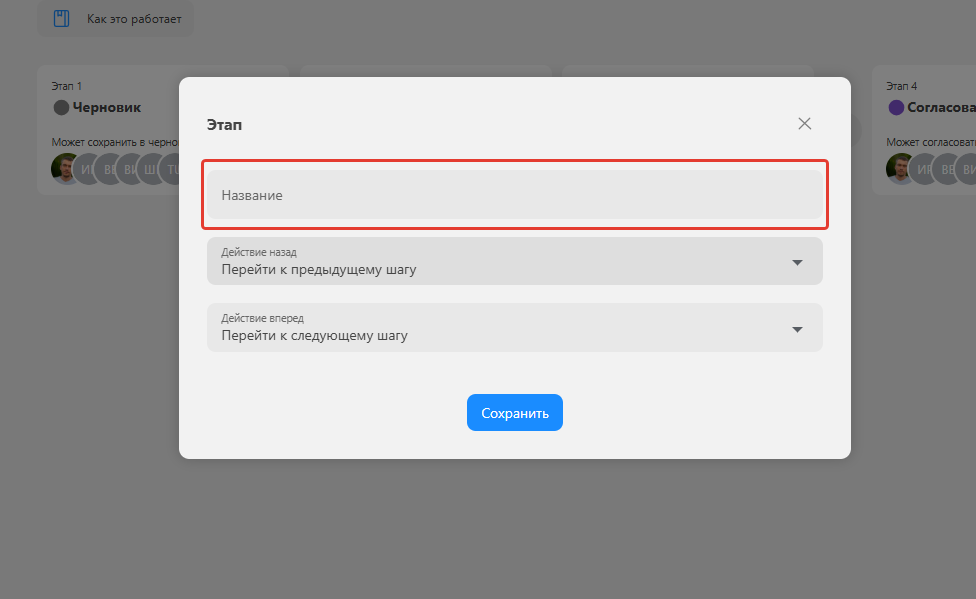
A step back can be configured to go to the previous stage or any other.
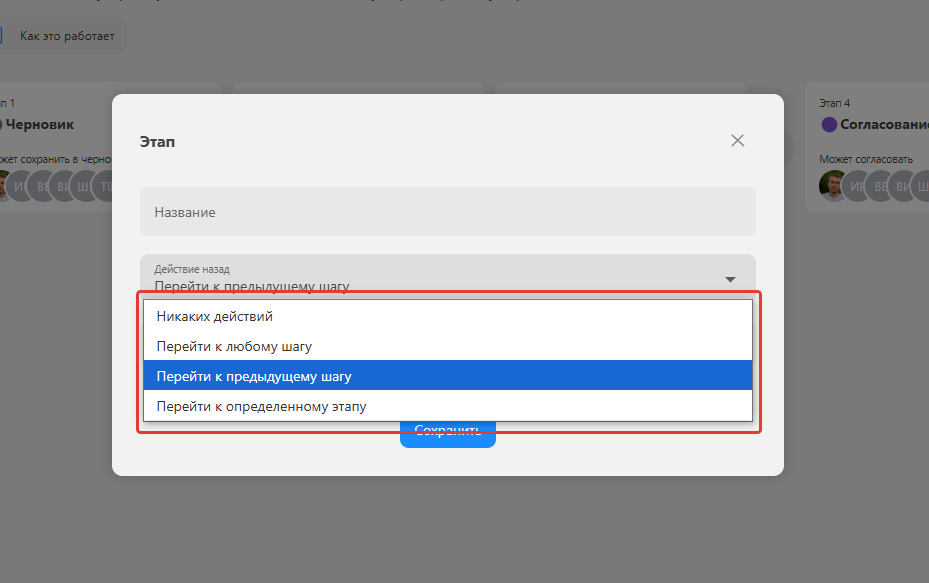
A step forward can also lead to the next stage or any specific one. This is especially useful if the process in your team is not linear: for example, after edits, a post skips the copywriter and goes directly to the designer for visual updates.
Each stage will appear on the board as a column. Posts can be easily moved between these columns - this way, the team quickly understands where everything is going according to plan and where there is a delay.
For example, an SMM specialist sees that the texts have been stuck at the "Design" stage for a while, but the visuals are still missing. And the client, opening the board, immediately understands which materials are awaiting approval - and does not ask again in the chat.
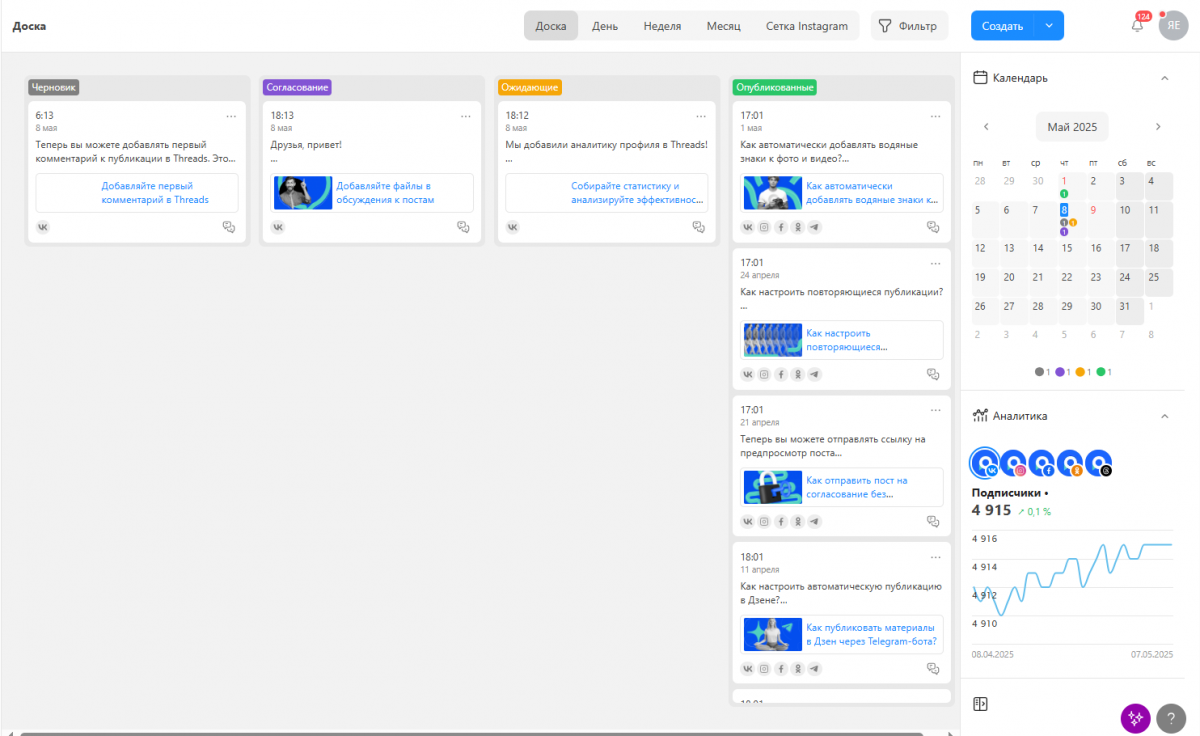
The stage board is a visual map showing the status of all tasks.
Once the stages are set up, the team has a clear structure that each post follows. However, just having a sequence of steps is not enough - most delays occur further along, during approvals. This is where materials get stuck if it's unclear who and when should check them. Therefore, the next important element of the workflow is proper approval settings.
Setting Up Approvals
Approvals can also be tailored to your team - from publication by click to multi-level checks. The flexible system helps eliminate unnecessary questions: who approves, within what timeframe, and what happens after approval.
There are several options:
-
Optional approval - you enable it manually when you need to get a colleague or client’s opinion. Example: the designer has finished the visuals, but the text is not fully ready. You send the post for optional review so that another editor can provide recommendations without blocking the entire publication chain.
 AI-ассистент отвечает в комментариях и сообщениях так, будто это живой менеджерБыстро, естественно, без пропусковУзнать подробнее
 -
Mandatory - after the chosen stage, the content automatically goes for review. The post will not move forward until someone with sufficient rights approves it. Example: the final text for social media goes to the project manager for approval right after being reviewed by the editor. This ensures that materials do not go into publication without final control.
-
Multi-level - when the material goes through several levels: text - visuals - final approval by the client. Each level has its own responsible parties assigned. Example: in a team of three, one is responsible for the text, another for the design, and the client is responsible for final confirmation. The post will not progress further until all levels are completed.
This approach saves time through transparency: everyone knows when and what they need to approve - notifications come via Telegram, the app, or email, depending on the choice.
We have discussed how to set up notifications in this article..
After setting up approvals, the team works more cohesively: everyone receives exactly the tasks that pertain to their role. The next step is to make working with the client even easier and eliminate the last barriers to content approval.
Involving the Client
Content approval often drags on because the client struggles to reach publication. They don't have time to search for the right chat and the necessary content. In Postmypost, this barrier is nonexistent.
The client does not need to create an account - just opening a link is sufficient. They immediately see the post, can leave a comment, or click "Approve." If there are many materials, a convenient feed helps display all posts awaiting attention.
Inviting the client to the service is easy: in the "Team" section, enter the client's email and assign a role: "Client" and "Approver."
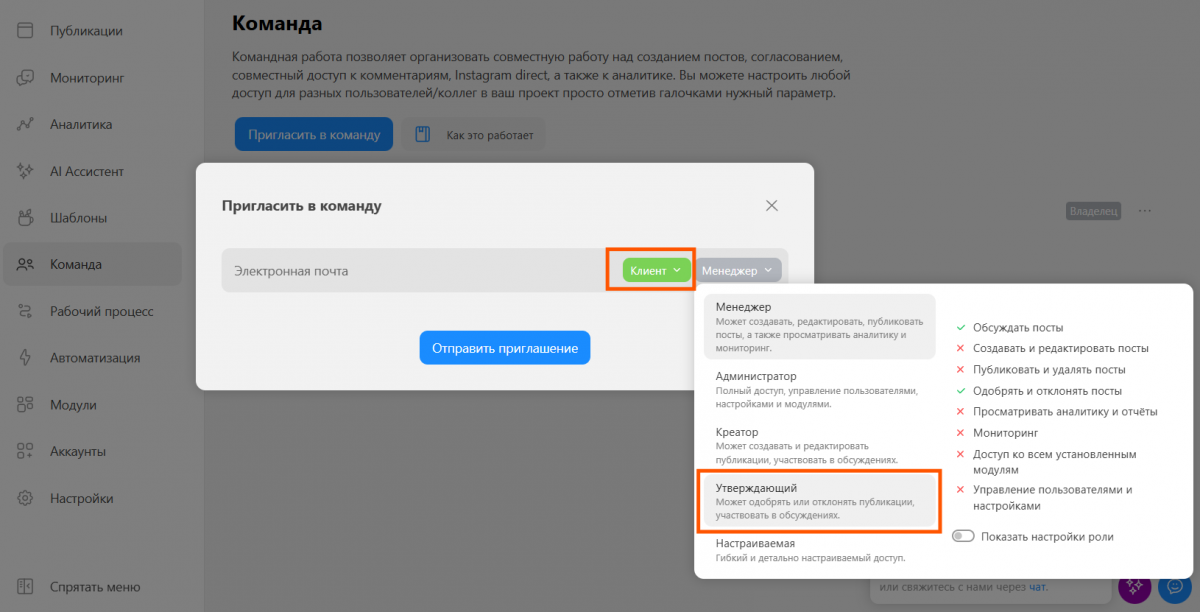
After that, the entire process works automatically, and the team spends less time on organization.
But it’s not enough to just publish content - it also needs to be analyzed. For convenience, reports in Postmypost are generated automatically - which means decisions can be made based on data rather than guesses.
Generating Reports
All stages of work in Postmypost are automated - even analytics. The service tracks statistics and updates them daily. This allows the team to see current metrics without unnecessary manual actions.
The "Analytics" section collects the main metrics for accounts and posts:
-
follower growth,
-
engagement,
-
reactions to specific publications,
-
audience dynamics by gender, cities, and countries.
This way, a marketer can instantly see that a post about a new promotion has received the most response from the audience in Moscow, while publications about product X perform better among women aged 25-34. This helps in planning content more effectively.
Here, you can also compare the results of promoted posts, look at the publication history, assess the effectiveness of different types of content, and choose the best time to release materials.
By the way, we studied when it's best to post on Telegram. We gathered the results in an article.
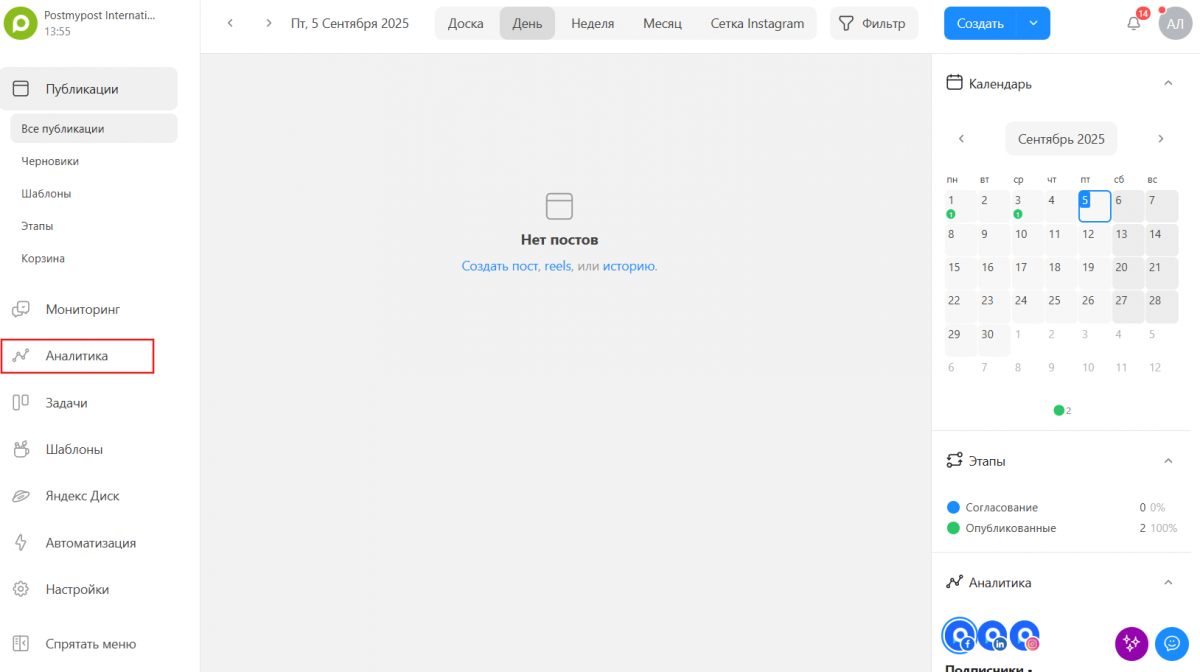
To obtain a report in Postmypost, simply open "Analytics."
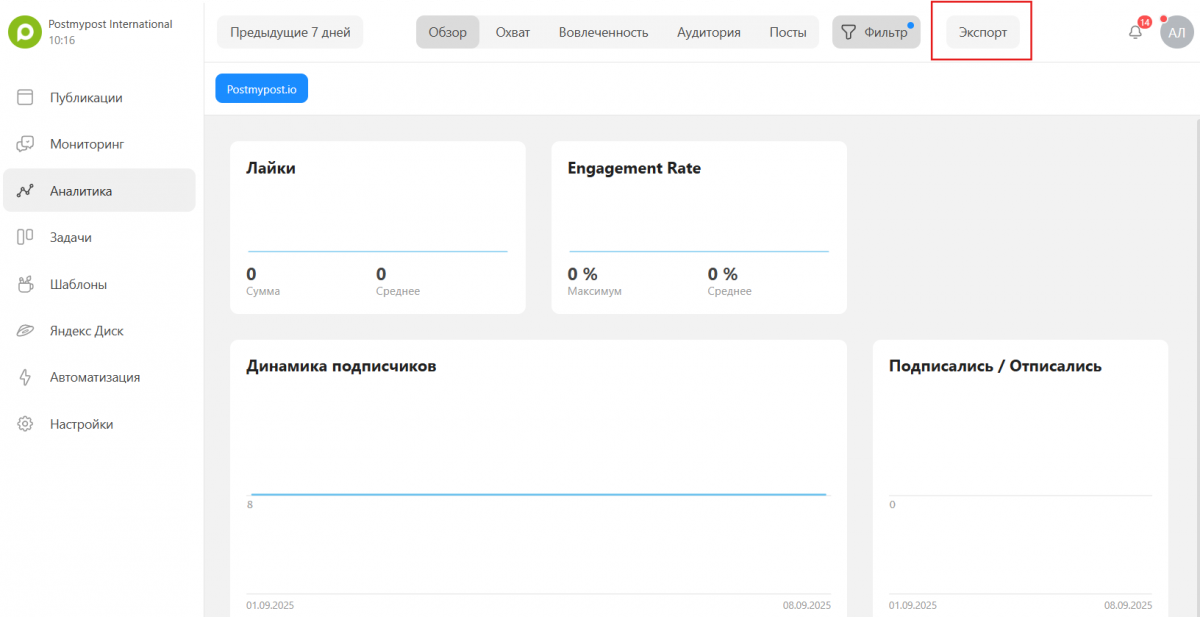
Click "Export."
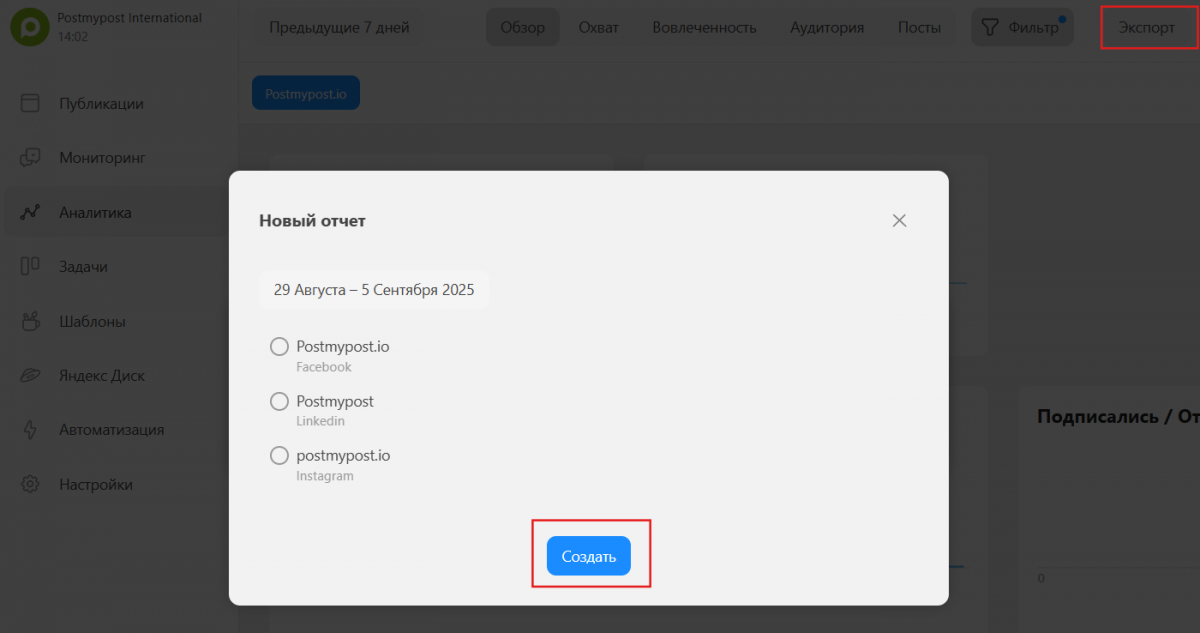
Choose the platform and click "Create."
The service will generate a ready document. Reports can be exported as PDF, and charts can be saved as images. If necessary, branding can be easily added: logo, title, and description (White Label mode).
In Postmypost, every step is designed to make the team's work clear and transparent, while the client gets involved without unnecessary actions. The result is fewer mistakes and questions like "who is holding up the post?" Try it out!
* The company Meta, which owns the social networks Facebook and Instagram, has been recognized as an extremist organization in Russia and is banned in the country.