Imagine: your content strategy is working excellently in Russia – videos are gaining traction, engagement is increasing, and reach is impressive. But you look at the statistics and think: "What if the same topic would take off in Brazil, Mexico, or Indonesia?" Reassembling the entire team, rewriting scripts, changing the visual style, and localizing humor for each culture can take months of work and huge budgets.
And now for the good news: you can achieve this with minimal sacrifices and still get organic traffic and reactions from a new audience.
Main Objectives When Testing Foreign Markets
When entering a new international market, key priorities usually boil down to three basic tasks.
-
Quickly and with minimal costs test how well the topic and format of the content resonate with a new audience.
-
Ensure that the value of the product/service is clear without deep cultural adaptations and explanations.
-
Get the first organic reach, engagement (likes, comments, shares), and genuine interest without completely restructuring the content strategy, team, or creative approach.
Ultimately, it is important to quickly decide whether to scale the new campaign further or switch to another country/language. This approach saves time, budget, and resources during the experimentation phase.
The Most Effective Method in 2025-2026: Translation and Dubbing of Videos
Take already prepared videos (Reels, Shorts, TikTok, YouTube) that are performing well in the domestic market and make them accessible to a new audience. Here’s how it looks in practice.
-
Select 5-10 of the most popular videos from the last 3-6 months.
-
Do the translation. Some use subtitles – because it's the simplest and quickest option. Others incorporate voiceover or AI dubbing. There are also cases where text in the new language is simply displayed on screen. Postmypost offers the most rational solution – but more on that later.
-
Publish on separate accounts or the same ones with geo-targeting/language settings.
-
Monitor the first 7-14 days: reach, CTR, comments.
In the end, the entire process takes from a few hours for preparation to 1-2 weeks for initial conclusions. You are not creating new content, not restructuring the strategy, and not spending huge budgets on localization – you are simply giving proven videos a "second life" in another language and market.
Why This Works Even Without Changing the Strategy
-
Language is the main barrier. People scroll through their feeds in their native language. Remove that, and the algorithm starts showing your content to a new audience.
 AI-ассистент отвечает в комментариях и сообщениях так, будто это живой менеджерБыстро, естественно, без пропусковУзнать подробнее
 -
Algorithms love "novelty." The same video, but in another language, is perceived as fresh content + more chances to appear in recommendations.
-
Content gets a second (and third, and fourth) life. One filming day provides reach in 4-5 countries instead of just one.
-
Costs are minimal. There’s no need for a new scriptwriter, operator, or editing – just translation + voiceover.
What Service to Use in 2026
Many platforms already offer built-in tools for adapting content to different languages – this is convenient for a quick start, but often requires manual adjustments, is limited in terms of languages, or the quality of dubbing.
-
TikTok – built-in AI voice dubbing + auto-translation of subtitles.
-
Instagram Reels – "Translate to..." feature with Meta AI: automatic dubbing and lip-syncing (synchronized lips), supporting English, Spanish, Portuguese, Kannada, and others (expanding).
-
YouTube Shorts – multilingual audio tracks + automatic subtitles, plus AI auto-dubbing.
-
YouTube long videos – adding multiple audio tracks in different languages, etc.
These built-in features are good, but they also have drawbacks: not always perfect synchronization, limited control over tone/style, manual activation for each video, issues with multilingual texts/hashtags, and lack of a unified scheduler for different time zones.
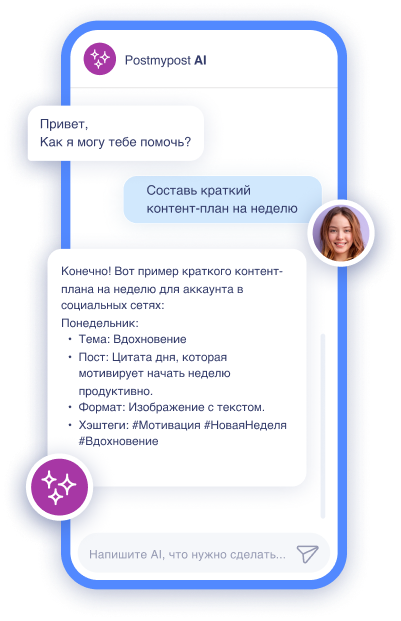
Postmypost has radically solved this issue: the service combines everything in one place with a powerful built-in AI assistant.
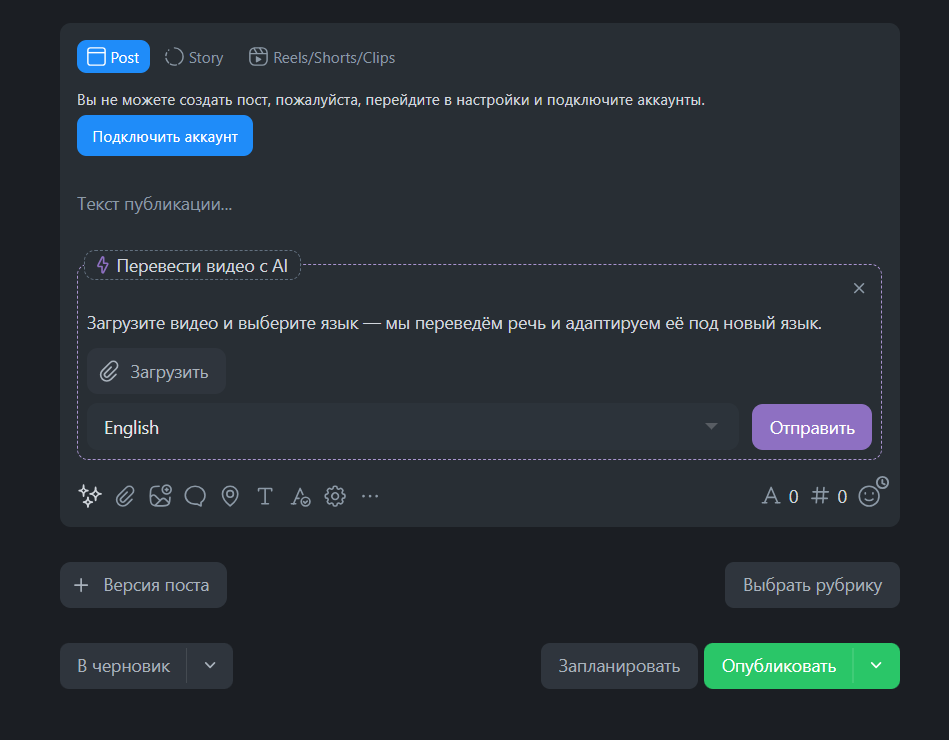
You upload a video once, and AI helps generate/edit texts, translate descriptions/hashtags/calls to action, adapt content to the required languages, and schedule publications for all accounts/countries considering local prime time. As a result, you get a video translated from Russian into one of dozens of available languages, with excellent synchronization, the required intonation, and additionally – with subtitles, all in just a few minutes. But that’s not all. Let’s list the main advantages of Postmypost considering the latest updates.
-
A single workspace for the entire team – no need to jump between platforms and editors, control employee access, and not worry about security.
-
The AI assistant helps adapt the tone of the content to a specific brand, generates ideas for a new audience, and works with references.
-
Automatic posting + analytics on reach/engagement by languages in one dashboard provides comprehensive insight into your market position.
-
Time savings by multiples – teams publish 6+ times faster, especially in multi-market situations.
If you want to scale your business without unnecessary chaos – Postmypost will ensure systematic growth.
Recommendations: How to Make the Launch as Effective as Possible
-
Start with 2-3 languages with high potential: Spanish (Latin America + Spain), Portuguese (Brazil), English (globally), Hindi (India).
-
Create separate accounts by language – this reduces the risk of "duplicate content" and allows the algorithm to target better.
-
Do not change the visual style and presentation – this is where the strength of the method lies. If a video resonates with Russian speakers, it is likely to resonate with Brazilians/Mexicans as well.
-
Add local hashtags and calls to action in the audience's language (but without rewriting all the text).
-
Track metrics separately – reach by countries, retention in the first 3 seconds, % views to completion.
-
Use delayed posting to avoid spending hours on manual publication in different time zones. Postmypost greatly simplifies life: upload the video once, adapt the text to the language, schedule the release at the right time for each country, and everything is published automatically. Plus analytics on reach and engagement all in one window.
Conclusion: One Content → Several Markets → Growth Without Extra Costs
Translating and adapting videos is one of the most effective and inexpensive ways to test foreign markets right now. You don’t have to disrupt your strategy, hire local creators, or spend huge budgets on experiments.
Start small: select 5-10 strong videos, translate, schedule publications, and check the numbers. If it works, scale it up. If not – just move on to the next couple of countries.