Familiar situation: in the morning, you sit down to work, open social media, and realize — there’s no post for today. Zero ideas — just like time, and with it, inspiration too. As a result, the publication ends up being rushed or postponed until tomorrow. And tomorrow, everything repeats.
This rhythm is exhausting. But there’s a solution — a content plan. It helps you think ahead about what and when you will publish, leaving room for spontaneous ideas. In this article, we will discuss how to plan content for a month.
Why you need a content plan
A content plan is not a routine and a restriction on creativity; on the contrary, it is support.
What does planning provide?
- Stable presence on social media. The audience receives a regular flow of posts.
- Time savings. It’s much easier to set aside a few hours a week to plan publications than to spend time pondering daily.
- A strategy. The plan will help connect content with goals: sales, audience growth, recognition.
A simple scheme for planning a month
At first glance, mapping out content for a month sounds cumbersome. But in reality, it involves just a few steps.
Step 1. Define your goals
Before planning publications, it’s essential to understand: why? If the goal is to increase sales, then the content should include space for product presentations, case studies, and testimonials. If the task is to grow followers, the focus is on engaging formats: challenges, games, useful tips. If the goal is to strengthen a personal brand, the content is built around expert materials and showcasing experience.
Goals suggest what the balance will be: for example, 60% useful content, 30% engaging, and 10% promotional.
Step 2. Choose topics and categories
To ensure the content doesn’t appear as a random assortment of posts, it’s convenient to break it down into categories. For example:
- useful (tips, instructions, checklists),
- behind the scenes (backstage, work processes, personal stories),
- entertaining (polls, memes, games),
- promotional (product reviews, sales, offers).
Step 3. Consider important dates and news events
Look ahead in the calendar and come up with topics for professional holidays — for example, Marketer's Day or Designer's Day. It’s helpful to study significant events planned in your niche and cover them as well. Another option is seasonal trends: back-to-school, New Year, “Black Friday.” Using relevant dates and events in your content makes the publications livelier and engages the audience more.
Step 4. Place posts in the calendar
Now you can distribute everything by days. Choose a comfortable frequency — 3–4 publications a week or every other day. The main thing is consistency, but posting too frequently can lead to unsubscribes.
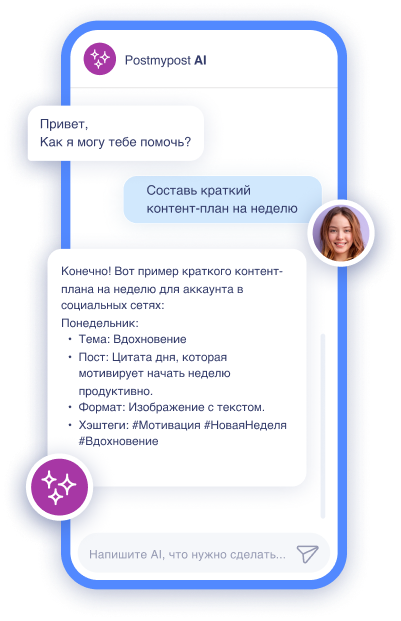
Here’s what a weekly plan might look like:
- Monday — useful post,
- Wednesday — behind the scenes,
- Friday — engaging format,
- Sunday — promotional or entertaining content.
In the end, you have a clear system: you know which posts will be published when. You spend less nerve and gain more time for creativity.
How to plan and avoid burnout
Even the most thought-out content plan can become a source of stress if approached too rigidly. It’s important to incorporate convenient techniques into the process and leave room for flexibility.
Work in blocks
One of the most effective ways to save time and reduce strain is to perform similar tasks in blocks. For example, write all texts for the next week on Monday. Prepare the designs for those posts on Tuesday. Shoot and edit videos on Wednesday.
This way, you don’t have to switch from task to task. It reduces fatigue and speeds up work.
Templates
Create or save a few basic templates in Canva and Figma: one for tips, one for behind-the-scenes, one for promotional posts. Then, you will only need to insert new photos or texts into them. You can edit the templates from the platforms and add brand colors and fonts — this way, your account will look more professional.
For texts, it’s convenient to write a general structure:
- for a promotional post: “Headline — Problem — Solution — Call to Action”;
- for a checklist or instruction: “Introduction — Steps — Tip — Question to the audience”;
- for an engaging post: “Introduction — Story/context — Question to the audience — Call for comments.”
Room for spontaneity
A plan is not a closed document. It’s essential to leave room for inspiration and unexpected events. Sometimes, it’s these kinds of posts that garner the most response.
For example, if you have 16 planned posts for the month, leave 2–3 days in reserve for fresh ideas or relevant news events.
Deferred posting services
Consistency is key to stable growth, but manually publishing each post is inconvenient and energy-consuming. Deferred posting services allow you to upload all materials in advance, distribute them across the calendar, and forget about manual publications. This is how Postmypost works, for example.
By example
Let’s imagine we are managing the account of a small online accessories store.
Step 1. Define goals
The main tasks for the store on social media are: showcasing expertise, engaging followers, and stimulating sales. For this, we will use several formats and categories: useful tips, polls and interactivity, product reviews, and news about promotions.
Step 2. Choose topics and categories
For example:
- Monday — care tips for accessories,
- Wednesday — behind the scenes, “How we package orders,”
- Friday — engaging post, “Which style do you prefer?”,
- Sunday — promotional post with product photography.
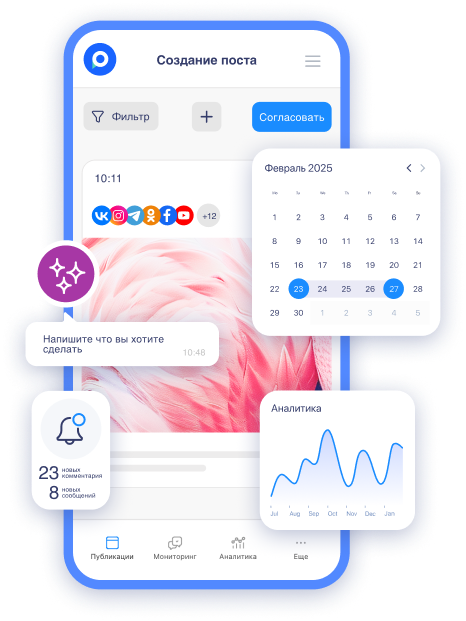
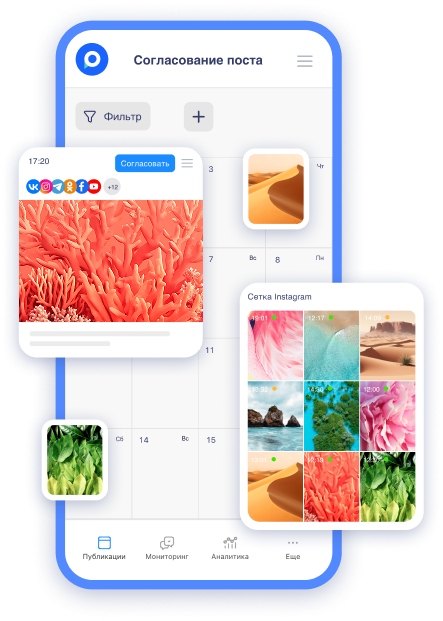
You can immediately schedule these posts on the required dates in Postmypost — this way, you will see the content distribution.
Step 3. Add important dates and news events
We check the calendar and see: soon it will be Teacher's Day and autumn sales. We include a post with a gift selection for the holiday and a promotional post with a limited offer in the plan.
Step 4. Plan content in Postmypost
Now we move on to practice:
- write texts and add illustrations in the post editor,
- set the publication time and choose the social networks where they should be published.
Step 5. Use auto-posting
When the needed day arrives, the posts are automatically published on Instagram*, VKontakte, and Telegram. As a result, we don’t spend time on manual publications — we only check the results.
A content plan provides peace of mind, saves time, and helps develop the account systematically. And with a service like Postmypost, you not only free yourself from routine but also create space for creativity.
* Instagram is owned by Meta, whose activities are banned in the Russian Federation.