Imagine: a brand publishes content every day — a post about a discount, a meme, a repost of the news. The team is trying hard, but the result is the same: few likes, even fewer requests. This is a typical situation where a company has content but lacks a strategy.
How do you write a promotion strategy? Let’s break it down step by step.
Define the Goal
The strategy answers the question: "Where are we going and for what purpose?" It has a larger goal: to increase brand awareness, attract leads, or build a community.
Examples of goals for brands:
-
Awareness — the brand is just entering the market and wants to be remembered. The goal is to increase reach by 30% within six months.
-
Sales — the company is already known but wants to convert followers into customers. The goal is to receive 200 new orders through social media in a quarter.
-
Community building — the brand is establishing long-term relationships. The goal is to increase engagement on social media by 20% and boost the number of UGC posts.
A clear goal helps to immediately cut out unnecessary activities. If your task is sales, then write it in the promotion strategy, specifying concrete figures.
Study the Audience
You can come up with a hundred ideas for posts and campaigns, but if they don't resonate with the audience — what’s the point? The promotion strategy is always built around people: who they are, what they want, and why they should choose your brand.
Target Audience Profile
"Women aged 25–34, Moscow" is just dry statistics. A more detailed profile is needed:
-
Demographics: age, gender, location, income;
-
Interests and lifestyle: what they are passionate about, how they spend their free time;
-
Behavior: how they choose products, what matters to them — price, service, emotions;
-
Motivation: why they need your product or service.
It's convenient to come up with 2–3 personas — imaginary representatives of your audience. They should have names, professions, and habits.
Anna, 28, marketer. Wants to quickly find new content ideas, values simplicity in services.
Dmitry, 35, business owner. Looks for clear reports, wants to see sales growth, not willing to spend time on details.
This way, the profile becomes lively rather than depersonalized, making it easier to identify the audience's pain points.
Pain Points and Insights
The audience is best described by its pain points — problems that hinder them and that your brand can solve.
Pain: "I spend too much time creating posts."
Solution: "Our service automates publications."
Insights run deeper. They are the reasons why a person isn't doing what they want.
Insight: "I want to look professional, but my account is empty because I can't keep up and don't know how to manage social media."
Audience Segmentation
It’s rare that a brand works with just one category of people. Usually, there are several segments, and each requires its own approach. For example, potential clients are not yet familiar with the product; they need unobtrusive explanatory content. Warm followers are interested but haven't purchased — we create cases, reviews, and special offers for them. Then we have loyal customers — they have already purchased the product and are satisfied. Therefore, we focus on engagement and community building.
Segmentation helps to build communication precisely.
Channels of Communication
Finally, it’s important to understand: the audience does not exist in a vacuum. They spend time in specific channels.
Young audiences are on TikTok, YouTube Shorts, and Telegram channels. International business audiences are on LinkedIn, Telegram channels, and niche media. Moms on maternity leave are on Instagram* and themed communities.
A mistake many brands make is trying to be everywhere. It’s much more effective to focus on 2–3 platforms where the audience is truly active and where you can work systematically.
Analyze the Market and Competitors
Before writing a strategy, it's useful to step out of your bubble and see what's happening around you. Competitors are not just enemies from whom we steal clients; they are also a free source of ideas, mistakes, and hints.
Start with the market: list direct and indirect competitors. Direct ones are those who sell the same as you. Indirect ones are those who meet the same need but in different ways. For example, for a fitness center chain, direct competitors would be other gyms, while indirect ones would be online workouts, personal trainers at home, and yoga studios.
Study their behavior:
-
In which channels are they active — Instagram*, Telegram, YouTube, do they use offline promotions.
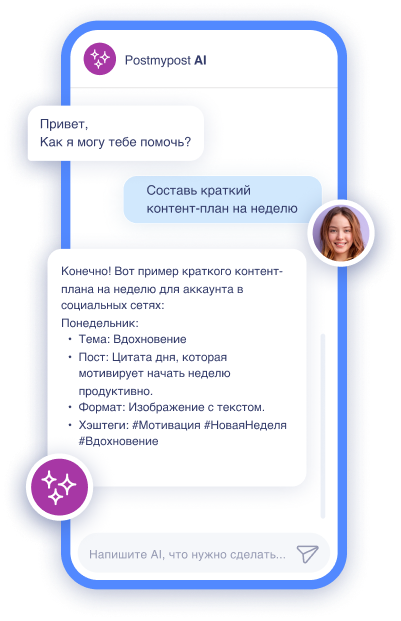 AI-ассистент отвечает в комментариях и сообщениях так, будто это живой менеджерБыстро, естественно, без пропусковУзнать подробнее
 -
What formats do they publish — videos, stories, podcasts, articles.
-
How do they interact with followers — do they respond to comments, conduct polls.
-
What unique selling propositions (USPs) do they communicate.
However, analyzing does not mean copying. Rather, it’s a way to understand what works for others and what doesn’t. In this way, you can borrow successful mechanics from competitors — for instance, challenges, interactives, types of columns. But avoid overloaded landing pages, spammy newsletters, and monotonous content without value.
Sometimes, it’s useful to conduct an audit of competitors' content: count the average number of reactions, comments, and reposts. This way, you can understand which format resonates.
How to Stand Out
If all competitors are making serious expert posts, you can play on irony and lightness. If the market is flooded with discounts and promotions, you can stand out with values and community. If everyone says "We are the best," try honesty: "We are a small team, but we pay maximum attention to each client."
The question you should ask yourself after the analysis is: "Why should the audience choose us?" The answer to this will become your strategic foundation.
Formulate Positioning
Positioning is how the brand looks and sounds to the audience. When you clearly articulate who you are and why, the strategy gains character and style. Without this, you will become just one of many.
Unique Selling Proposition (USP)
The USP is a brief answer to the question: "Why us?". It’s important that this is a unique value, not a set of general words like "quality, reliability, customer orientation."
Poor: "We have a quality email service."
Better: "Create email campaigns in 3 minutes, even if you're a beginner."
The USP should be simple, clear, and easily translatable in communication.
Tone of Voice (ToV)
Often, the style of communication with clients says more about the brand than the logo or design.
There are several distinct types of ToV:
-
Official, expert. Suitable for banks, medical companies, B2B.
-
Friendly, ironic. For lifestyle brands, marketing services.
-
Inspirational, motivational. Works organically in educational projects and charitable initiatives.
The main thing is to be consistent. If a brand publishes memes today and writes in a dry business tone tomorrow, the audience gets confused.
Values
These are long-term guidelines. They determine how the brand behaves in the market, with the audience, and within the team. Values help in decision-making and filtering ideas.
For example, a service for repairing gadgets claims to care about the customer. This means the company does everything to ensure that the interaction is comfortable. It quickly responds to comments and messages in DMs. It operates 24/7. It publishes useful tips and instructions — even if they don't lead to immediate sales. The audience feels valued and heard. This boosts loyalty and trust, and trust is key to repeat sales and engagement.
Another example is a tech brand that values innovation. It is constantly seeking new solutions and shows that it keeps up with the times. How is this reflected in content? Through constant demonstration of new product features in videos, stories, and posts. The brand publishes cases and shows how innovations helped clients achieve results. It also engages with trends and experiments: participates in new formats and unconventional campaigns, and tests technologies itself.
In other words, positioning helps the audience recognize the brand even without a logo. From a single post, a follower can say, "Ah, that's them."
Define the Channels and Tools for Promotion
Once the goal and positioning are clear, the main question arises: "Where exactly will we promote ourselves?" There are many channels, but not all are suitable for the brand and its audience. The task of the strategy is not to cover everything, but to choose the optimal points of contact.
Social Media
Social media is the most flexible promotion tool. It’s important to choose the right platform:
-
Instagram* — visual content, stories, working with bloggers, a good tool for lifestyle brands and small businesses.
-
TikTok — short videos, trends, viral reach. Suitable for a young target audience.
-
Telegram — texts, quick news, privacy. Works well for experts, media, and B2B.
-
VKontakte — a versatile platform: community, music, video, advertising.
-
LinkedIn — B2B and professional contacts for international partners.
Blog
A blog on the website is a long-term tool for attracting traffic from search engines and increasing expertise.
Articles with practical tips and guides, cases and analyses from your practice, trend and industry news reviews will work well.
Newsletters
Email and messenger newsletters are a great way to recapture the audience's attention. Unlike social media, you are not dependent on algorithms.
There are two main channels:
-
E-mail: digests, article collections, special offers;
-
Telegram, WhatsApp: quick notifications, promotions, new products.
Offline
Don’t underestimate offline tools — they often create a strong emotional impact.
Choose a format that suits the brand: participation in conferences and exhibitions, partner events and collaborations, POS materials at points of sale — flyers, merchandise, QR codes linking to social media or the website.
How to Choose Formats and Frequency
Look at the audience — if your clients don’t read long texts, the blog may take a back seat. Consider resources — it’s better to consistently manage one social media platform and send newsletters than to unsuccessfully abandon five channels.
Synchronize formats — one piece of content can be adapted for different platforms: an article from the blog can easily turn into a version for newsletters and quotes for posts.
Create a Content Plan
Once the channels are selected, it’s time to turn the promotion strategy into a clear working document — a content plan. It helps to move away from chaotic ideas and establish a system.
Categories are the skeleton of the content. They set the structure and help maintain balance. They can include:
-
Expert materials — cases, instructions, trend analyses,
-
Entertaining content — memes, jokes, interactives,
-
UGC — customer stories, surveys, reposts of their posts,
-
Sales — product announcements, promotions, special offers,
-
Image posts — brand values, behind the scenes, company culture.
A good scheme is 60% value (expert + community), 20% image, 20% sales.
At the same time, the content plan should include various formats to keep attention:
-
Texts — short posts, articles,
-
Visuals — photos, carousels, infographics,
-
Videos — shorts, live broadcasts, webinars,
-
Interactive — polls, quizzes, challenges.
Metrics and KPIs
It’s not enough to know how to write a brand strategy — you need to be able to assess its effectiveness. For this, it’s important to specify the metrics in the document by which you will measure success:
-
Engagement: likes, comments, saves, clicks;
-
Reach and impressions: how many people saw your content;
-
Requests and leads: the number of inquiries in DMs, filled forms, newsletter subscriptions;
-
Sales: the ultimate goal, measured through CRM or website analytics.
Tip: record starting values to see growth and avoid working blindly.
A good promotion strategy is not a bulky document of hundreds of pages but a clear and functional system. It answers the main question: how our marketing actions help the business grow. It’s better to review it at least once every six months: test hypotheses, adjust formats, and update KPIs.
* Instagram is owned by Meta, recognized as an extremist organization in the Russian Federation.